
This child did not pass a hearing screening (performed using both behavioral (pure-tone audiometry) and non-behavioral (otoacoustic emissions) methods) at their preschool. This screening was performed by experienced screeners with the UCSF Children’s Communication Center, part of the UCSF departments of Audiology and Otolaryngology-Head and Neck Surgery.
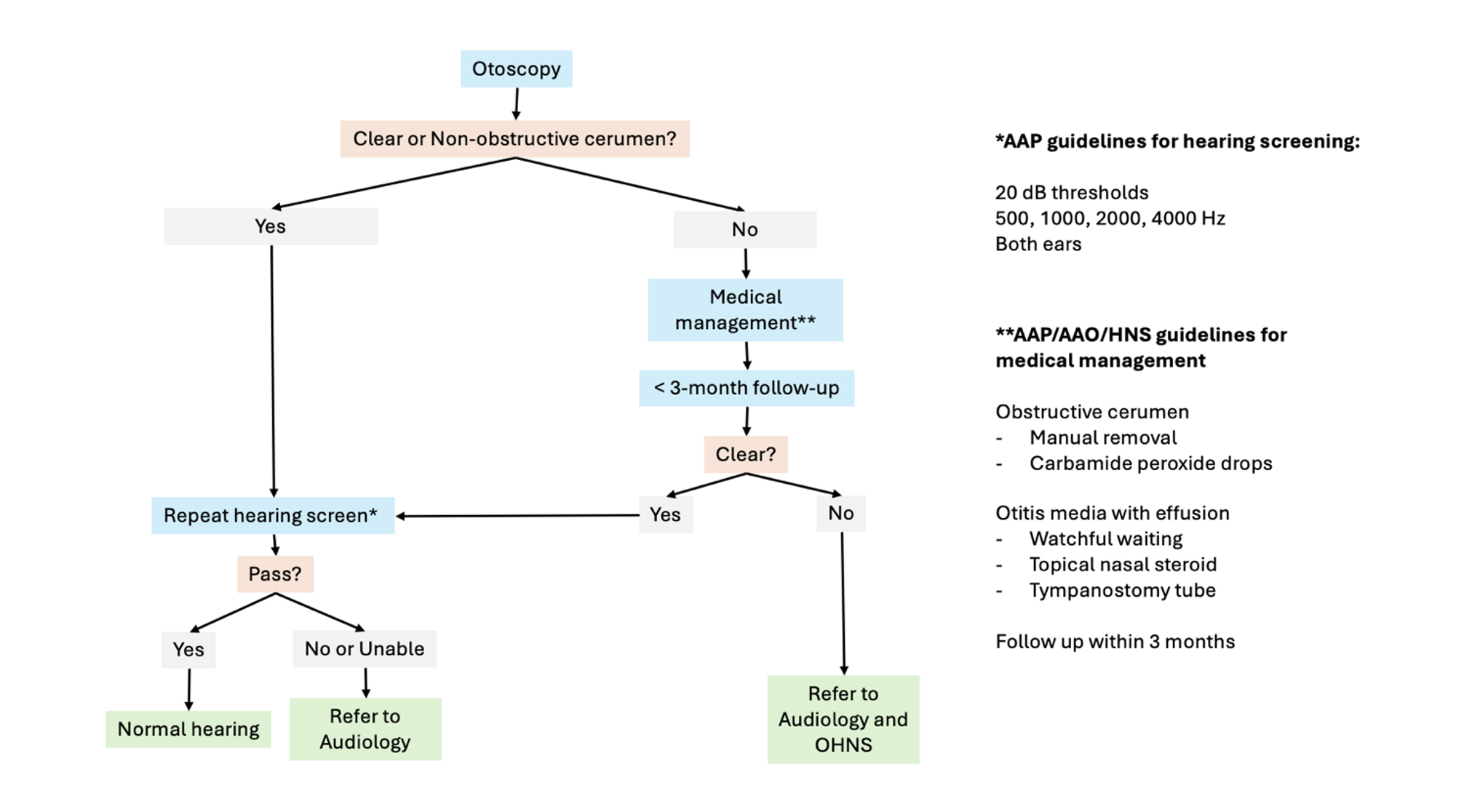
Thank you for participating in this child’s hearing care by evaluating and treating any otologic pathology (especially cerumen and otitis media) and supporting definitive hearing testing after management. We have developed the diagnostic algorithm below in accordance with Clinical Practice Guidelines and in collaboration with regional and national stakeholders, including pediatricians, audiologists, and hearing screening experts.
We greatly appreciate your partnership in supporting pediatric hearing care. Should you have any questions or concerns about these recommendations, we welcome your feedback! Please feel free to e-mail the UCSF Children’s Communication Center at [email protected].
Further details are provided for the following common situations:
If this box is checked on the referral form, it means that the child’s teacher and/or caregiver has expressed concerns about their child’s hearing, speech, or language. According to the Joint Committee on Infant Hearing 2019 guidelines (QR code to right), any child with these concerns should be directly referred for full diagnostic audiologic evaluation, regardless of hearing screening status. Please refer to Audiology.
> 2019 JEHDI Guidelines for Early Hearing Detection and Intervention Programs
If your otoscopy is clear and/or there is only a small amount of non-occlusive cerumen, sound is able to pass adequately through the ear canal and middle ear. If you have the ability to perform hearing screening in your office, please perform a hearing re-screen in your office in accordance with AAP 2009 guidelines (QR code to right) as documented on the referral form (20 dB SPL thresholds at 500, 1000, 2000, and 4000 Hz in both ears). If the child passes, we conclude that their hearing is normal. If the child does not pass, please refer to Audiology. If you are not able to perform a hearing re-screen in your office (including if this is a younger child or child with developmental delay who is not able to participate fully in screening), please refer to Audiology.
Presence of middle-ear effusions is common during and after acute otitis media and can persist for months. Chronic middle-ear effusions can be associated with ongoing conductive hearing loss and be a risk factor for speech and language delays; persistent middle-ear effusions for > 3 months or recurrent acute otitis media may be an indication for referral to audiology for hearing testing and/or otolaryngology for evaluation for ear tubes (2014 AAP guideline (QR code to right)). If you see middle-ear effusions on otoscopy today, please perform medical management or watchful waiting in accordance with your practice and see the child in follow-up within 3 months. If effusions have cleared at that time, please repeat OAE or pure tone hearing screening if available. If effusions have not cleared, please refer to Audiology.
Whereas non-occlusive cerumen does not impede the conduction of sound, completely occlusive or impacted cerumen can cause a mild conductive hearing loss. Please manage this cerumen according to your clinical practice, which may include manual disimpaction, carbamide peroxide drops, and/or referral to Otolaryngology-Head and Neck Surgery. Please also advise parents to refrain from using cotton-tip applicators to clean their child’s ears at home, as this is ineffective and may exacerbate the problem by forcing the cerumen deeper into the ear canal.
It is very common for children 3 and under, some 4-year-olds, and children with developmental delays to not be able to complete pure-tone audiometric (behavioral) hearing screening. Also, many primary care providers do not have the capacity or equipment to perform hearing screening. If you are not able to perform hearing screening in your office, please refer to Audiology for diagnostic audiogram.
Access to Audiology can be challenging. If you are having trouble identifying an Audiologist to refer your patient, please contact us at [email protected] so we can provide a list of audiology practices that can accept your patient, or refer to the resource page below.
For more information, please contact:
Children's Communication Center
Phone: (415) 353-2012
Email: [email protected]
Follow Us on Instagram
Stay updated on the latest news, events, and behind-the-scenes moments from UCSF CCC!