
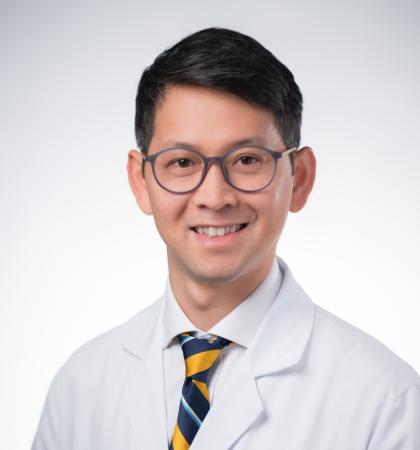
Dr. Y Song Cheng is a fellowship-trained neurotologist and skull base surgeon who cares for patients with hearing loss, balance disorders, and complex ear and skull base conditions. His goal is to help people hear better and live well at every stage of life. He brings the latest surgical techniques to his patients, from minimally invasive endoscopic ear surgery to awake procedures for those who cannot safely undergo general anesthesia. His clinical practice and research are based at UCSF, and he also serves as Lead Otologist at Zuckerberg San Francisco General Hospital.
Dr. Cheng offers the full range of ear and lateral skull base surgery, with an emphasis on restoring hearing.
- Conductive hearing loss: eardrum repair (tympanoplasty), reconstruction of the hearing bones (ossiculoplasty), and bone-conduction hearing implants
- Otosclerosis: stapes surgery to restore hearing
- Cochlear implantation: for adults with severe hearing loss or single-sided deafness, including elderly and medically complex patients
- Cholesteatoma and chronic ear disease: minimally invasive endoscopic surgery, often performed through the ear canal without an external incision
- Cerebrospinal fluid (CSF) leaks: repair of spinal fluid leaks into the ear
- Vestibular schwannoma (acoustic neuroma) and NF2-related schwannomatosis: surgery with hearing preservation and nerve monitoring, observation, and hearing rehabilitation
- Ménière's disease: medical management, with surgical options for vertigo that does not respond to treatment
- Superior canal dehiscence syndrome: Counseling and surgical treatment of symptomatic patients informed by years of research on the condition
- Surfer's ear (exostoses): surgery to widen the ear canal
- Awake surgery. For patients who are poor candidates for general anesthesia, including select older adults, he performs cochlear implantation, stapes surgery, and select tympanoplasties under local anesthesia with sedation.
Research
Dr. Cheng has a background in ear mechanics research and studied superior canal dehiscence at Harvard Medical School and Mass Eye and Ear. He now directs the Schindler Temporal Bone Laboratory at UCSF, where his team is developing endoscopic optical coherence tomography, a light-based technique for imaging the inner ear. He is a co-investigator on a five-year, $3.5 million multi-institutional grant from the National Institutes of Health. His other work includes:
- Cochlear implant outcomes and surgical decision-making in older adults
- Speech-to-text technology to help patients with hearing loss communicate during medical visits
- Intraoperative nerve monitoring to preserve hearing and facial nerve function during skull base tumor surgery
- Inner ear gene therapy, as a site co-investigator and surgeon in a clinical trial for inherited deafness
- Automated hearing screening at Zuckerberg San Francisco General, bringing hearing care to patients who might otherwise go without
To support this work, contact: [email protected].
Teaching
He received the Chief Resident Teaching Award at NYU and, more recently as a UCSF faculty member, the 2026 Roger Boles Award for Excellence in Teaching. He is the Deputy Program Director of the UCSF Neurotology Fellowship.
Education and Training
- Undergraduate: King’s College London, University of London
- Medical School: University of Oxford (BM BCh)
- Residency: New York University – Otolaryngology–Head & Neck Surgery
- Fellowship: Massachusetts Eye and Ear / Harvard Medical School – Otology/Neurotology